What’s inside
MemoFixed ingredients & supplement facts
Everything inside each MemoFixed capsule, in plain English: what each key ingredient is, what research suggests, the full label and who should check with a doctor first.
Updated 13 November 2026 · MemoFixed Australia
Quick answer
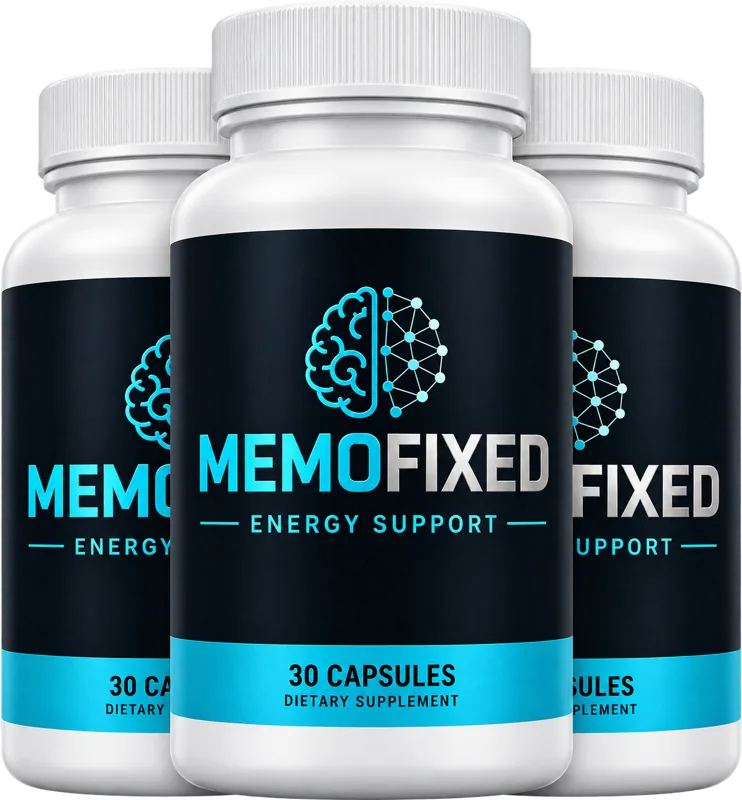
MemoFixed contains vitamins, minerals, choline and a 609 mg proprietary blend of botanicals and other compounds in each two-capsule serving. It contains soy and fish (tuna), and the amount of each individual blend ingredient is not disclosed.
- Serving
- 2 capsules a day
- Per bottle
- 60 capsules · 30-day supply
- Formula
- 22 vitamins & minerals + 18-ingredient blend
- Allergens
- Contains soy and fish (tuna)
- Subscription
- None — one-off purchase
- Guarantee
- 180-day money-back
MemoFixed prices in AUD · free shipping
What ingredients are in MemoFixed?
The tables below separate what the label quantifies from what it only names. This distinction helps you compare products, avoid doubling up on nutrients and take useful information to your pharmacist. MemoFixed is a daily supplement for healthy memory and focus support, not a treatment for a medical condition.
Key ingredients, one by one
Here are the best-known ingredients in the MemoFixed blend and why people look for them. Individual amounts inside the blend are not listed on the label, and MemoFixed as a finished product has not been clinically studied, so the research notes describe the ingredient, not this product.
Bacopa monnieri (whole herb extract)
A traditional Ayurvedic herb, often called brahmi, long used for memory and learning.
Research: A 2014 review of nine trials found standardised extracts improved some attention and memory test results after 12+ weeks.
Read the full guide →Phosphatidylserine (from soy)
A fat-like compound naturally found in the membranes of brain cells.
Research: A six-month Japanese trial of soy-based phosphatidylserine reported mixed results, with some benefit in certain memory measures in older adults.
Read the full guide →Huperzine A (Huperzia serrata)
A natural compound from Chinese club moss, studied for how it affects acetylcholine, a messenger the brain uses for memory.
Research: Reviews describe the evidence as limited and call for better studies. Ask your pharmacist first if you take other medicines.
Read the full guide →DHA 14%
An omega-3 fat found in fish oil and a major building block of the brain.
Research: The US National Institutes of Health notes DHA is concentrated in the brain and eyes; trial results on memory in healthy adults are mixed.
Green tea leaf extract
A plant extract containing natural antioxidants and small amounts of caffeine.
Research: The US NCCIH summarises green tea research as promising in some areas but not conclusive.
Choline, vitamin B6, B12-family and folate
Nutrients with normal roles in energy and nerve function. Choline is used to make acetylcholine.
Research: These amounts are listed exactly on the label (for example B6 12 mg, choline 50 mg), so your pharmacist can check overlap with other vitamins.
Grape seed and bilberry extracts
Fruit extracts rich in plant polyphenols, popular in antioxidant formulas.
Research: Small trials of standardised grape extracts in older adults are encouraging but early.
Full supplement facts: per two-capsule serving
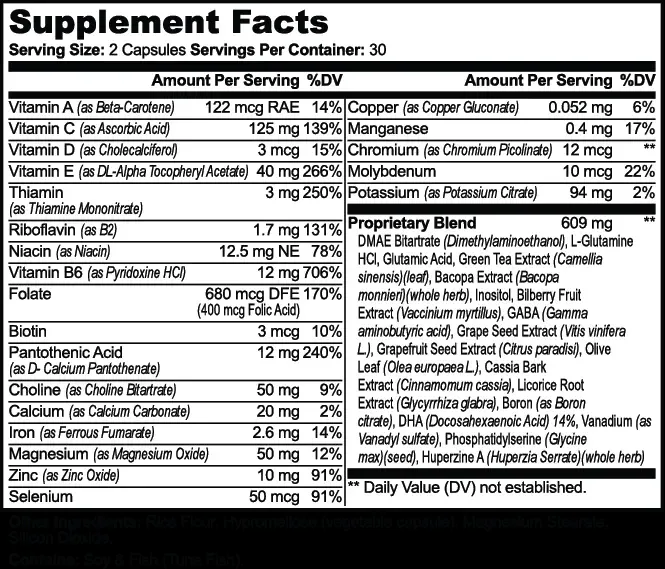
The serving size is two capsules, and a bottle provides 30 servings: a 30-day supply at the suggested daily intake. Every row below reproduces the supplied Supplement Facts values, including the ingredient forms, amounts and displayed Daily Value percentages.
Per serving means the quantity in two capsules together, not in each capsule. The %DV column is the label’s Daily Value reference, not a personalised recommendation or a measure of how much your memory might improve. The ** symbol is reproduced from the source panel; its footnote states that Daily Value is not established.
Large percentages should not be interpreted as stronger memory benefits. Your total intake also depends on food, fortified drinks, multivitamins and any separate nutrient supplements. Bring all of those products into a medication and supplement review rather than checking this label in isolation.
| Ingredient | Per serving | %DV |
|---|---|---|
| Vitamin A (as Beta-Carotene) | 122 mcg RAE | 14% |
| Vitamin C (as Ascorbic Acid) | 125 mg | 139% |
| Vitamin D (as Cholecalciferol) | 3 mcg | 15% |
| Vitamin E (as DL-Alpha Tocopheryl Acetate) | 40 mg | 266% |
| Thiamin (as Thiamine Mononitrate) | 3 mg | 250% |
| Riboflavin (as B2) | 1.7 mg | 131% |
| Niacin | 12.5 mg NE | 78% |
| Vitamin B6 (as Pyridoxine HCl) | 12 mg | 706% |
| Folate (400 mcg Folic Acid) | 680 mcg DFE | 170% |
| Biotin | 3 mcg | 10% |
| Pantothenic Acid (as D-Calcium Pantothenate) | 12 mg | 240% |
| Choline (as Choline Bitartrate) | 50 mg | 9% |
| Calcium (as Calcium Carbonate) | 20 mg | 2% |
| Iron (as Ferrous Fumarate) | 2.6 mg | 14% |
| Magnesium (as Magnesium Oxide) | 50 mg | 12% |
| Zinc (as Zinc Oxide) | 10 mg | 91% |
| Selenium | 50 mcg | 91% |
| Copper (as Copper Gluconate) | 0.052 mg | 6% |
| Manganese | 0.4 mg | 17% |
| Chromium (as Chromium Picolinate) | 12 mcg | ** |
| Molybdenum | 10 mcg | 22% |
| Potassium (as Potassium Citrate) | 94 mg | 2% |
| Proprietary Blend | 609 mg | ** |
Every ingredient in the proprietary blend
The following ingredients share a total blend weight of 609 mg. The descriptions explain what they are and why they commonly appear in supplements; they are not promises that MemoFixed produces a particular result. The label does not provide a separate quantity for any row.
| Ingredient | What it is | Why it's commonly used |
|---|---|---|
| DMAE bitartrate | A compound supplied as a bitartrate salt. | Included in some formulas marketed for mental alertness. |
| L-glutamine HCl | An amino acid supplied as a hydrochloride form. | Used as an amino-acid ingredient in mixed supplements. |
| Glutamic acid | An amino acid. | Included in some amino-acid and brain-support formulas. |
| Green tea leaf extract | An extract of green tea leaves. | Used for its plant compounds in antioxidant-focused formulas. |
| Bacopa whole herb extract | A botanical extract from Bacopa. | Traditionally used for memory and learning; selected extracts have been studied. |
| Inositol | A naturally occurring compound involved in cell signalling. | Used in a range of nutritional formulas. |
| Bilberry fruit extract | A fruit-derived botanical extract. | Commonly included for its antioxidant-associated plant compounds. |
| GABA | Gamma-aminobutyric acid, a chemical messenger. | Included in some calmness-focused supplements; oral effects are not established by its normal role. |
| Grape seed extract | An extract from grape seeds. | Used for its plant polyphenols in antioxidant-focused supplements. |
| Grapefruit seed extract | A seed-derived botanical extract. | Used as a botanical component of mixed formulas. |
| Olive leaf | A botanical ingredient from olive leaves. | Included in general wellbeing and plant-compound formulas. |
| Cassia bark extract | An extract from cassia bark. | Used as a botanical component in mixed supplements. |
| Licorice root extract | An extract from licorice root. | Included in traditional botanical and mixed formulations. |
| Boron (as boron citrate) | A trace element supplied as a citrate. | Used in some multi-nutrient supplements. |
| DHA 14% | An ingredient containing the omega-3 fatty acid DHA. | DHA is a structural component of the brain; the label does not disclose a DHA dose. |
| Vanadium (as vanadyl sulfate) | A trace element supplied as vanadyl sulfate. | Included in some trace-element blends. |
| Phosphatidylserine (soy) | A soy-derived phospholipid found in cell membranes. | Used in memory-support formulas; ingredient research is mixed. |
| Huperzine A (Huperzia serrata whole herb) | A compound associated with Chinese club moss. | Studied for its effect on acetylcholine breakdown; medication review is important. |
About the 609 mg blend amount
The proprietary blend total is a combined weight, not 609 mg of Bacopa, phosphatidylserine, Huperzine A or DHA. Dividing that number by the number of listed ingredients would not give meaningful individual amounts. Nor should you estimate a dose from the position of an ingredient in the list.
The phrase DHA 14% describes the listed DHA ingredient; it is not a disclosed milligram amount of DHA per serving. Likewise, Huperzine A appearing by name does not reveal its microgram quantity. Without those details, comparisons with single-ingredient clinical studies remain limited.
If knowing an exact ingredient amount is important to your decision, treat its absence as an uncertainty rather than filling the gap with an assumption. Do not increase the number of capsules to imitate a research dose: that would raise every disclosed vitamin and mineral as well as the blend.
Vitamins and minerals: read the quantities in context
The label separates measured nutrients from the proprietary blend, making it possible to check specific amounts such as vitamin B6 12 mg, magnesium 50 mg and choline 50 mg per serving. These are useful numbers when your pharmacist checks overlap with a multivitamin or other daily supplements.
Nutrients have normal roles in the body, but supplying a nutrient does not automatically improve a function beyond normal levels. This page does not establish whether you have a deficiency or need an additional intake. Your medical history, diet and other products all matter to that assessment.
Units are also important. Milligrams and micrograms are different, while RAE and DFE are label expressions for particular vitamin quantities. Compare like with like rather than adding differently expressed numbers yourself. The supplied folate row states both 680 mcg DFE and 400 mcg folic acid so you can show the complete information to a professional.
What the research does and doesn’t tell us
Some ingredients have been studied as individual preparations. For example, the Calabrese Bacopa trial tested a standardised extract at 300 mg daily for 12 weeks in older adults. The Kato-Kataoka phosphatidylserine trial tested soybean-derived PS at 100 mg or 300 mg daily for six months, with mixed overall and subgroup findings.
Those studies did not test MemoFixed. Different extracts, undisclosed amounts and a multi-ingredient formula prevent a direct comparison with the trial preparations. MemoFixed itself has not been clinically studied, so it should not be described as clinically proven on the basis of those references.
The dedicated Bacopa monnieri, phosphatidylserine and Huperzine A guides explain the research and its limits in more detail. They are useful companions to the label, especially if a study name has influenced your decision. Ingredient plausibility and finished-product evidence are separate questions.
Allergens and other ingredients
The label states that MemoFixed contains soy and fish (tuna). Do not take it if you are allergic to either. A vegetable capsule shell does not make the whole formula vegetarian, vegan or free from fish-derived ingredients.
The other ingredients are rice flour, hypromellose (vegetable capsule), magnesium stearate and silicon dioxide. These are listed separately from the measured nutrients and proprietary blend. If you have a specific sensitivity, show the full list to your pharmacist rather than relying on a front-of-bottle description.
This guide does not add unverified free-from or manufacturing claims. The safest approach is to use the declared allergens and the complete current label when assessing suitability. If the bottle you receive differs from information online, ask for clarification before taking it.
Who should get professional advice first?
Ask a doctor or pharmacist before starting if you take prescription medicines, use other supplements, have a medical condition or have surgery planned. Bring the complete label and an up-to-date medicine list. Reviewing just Bacopa or just the vitamins would miss other components that could affect suitability.
Pregnancy, breastfeeding and use under 18 also require individual medical advice. MemoFixed contains iron: keep it out of reach of children. If you suspect an adverse reaction, stop taking it and seek advice rather than assuming an ingredient must be harmless because it is natural.
New or worsening memory problems deserve a medical appointment, particularly if they interfere with daily activities. A supplement label cannot identify their cause. MemoFixed is not intended to diagnose, treat, prevent or reverse dementia or any other disease.
Before you start: a quick checklist
Before deciding, check the two-capsule serving, compare the measured nutrients with your other products, and note the undisclosed blend amounts. Then check the soy and fish warning and discuss medicines or health conditions with a professional. These steps are more useful than judging a formula by how many ingredients it contains.
If the product is suitable for you, follow the how-to-take MemoFixed guide: two capsules once daily, 20–30 minutes before a meal with a glass of water, or as your healthcare professional directs. Do not exceed the recommended amount or add separate ingredients merely to match study numbers.
Our 180-day Aussie promise
Try MemoFixed for up to 180 days. If it's not right for you, email us for a refund of the product price. Refund policy
Common questions
What are the main ingredients in MemoFixed?
MemoFixed contains vitamins, minerals and choline alongside a 609 mg proprietary blend. The blend includes Bacopa, phosphatidylserine, Huperzine A, DHA 14% and other listed ingredients.
Are MemoFixed ingredient amounts disclosed?
The label gives individual amounts for the listed vitamins, minerals and choline. It gives only a combined 609 mg total for the proprietary blend, not separate amounts for its components.
Is the supplement facts table per capsule?
No, the amounts are per serving of two capsules. A bottle contains 30 of those servings, providing a 30-day supply at the suggested daily intake.
Does MemoFixed contain soy or fish?
Yes, it contains soy and fish (tuna). Do not take it if you are allergic to either, even though the capsule shell is vegetable-based.
How much Bacopa is in MemoFixed?
The individual Bacopa amount is not disclosed. The 609 mg figure is the whole blend total and cannot be treated as the Bacopa dose.
Does DHA 14% mean 14 mg of DHA?
No, that wording is not a disclosed DHA quantity per serving. The label does not provide enough information to calculate the DHA dose from the blend total.
Is MemoFixed clinically proven?
MemoFixed itself has not been clinically studied. Research on specific ingredient preparations does not prove that its finished formula produces the same results.
Can I combine MemoFixed with a multivitamin?
Ask your pharmacist to check the complete labels first. Combining products can increase overlapping nutrients, so the measured amounts and all blend ingredients should be reviewed together.
Does MemoFixed contain caffeine?
The label lists green tea leaf extract, which naturally contains some caffeine, but no caffeine amount is given. If you are sensitive to caffeine, ask your pharmacist and avoid taking it late in the day.
Is MemoFixed vegetarian or vegan?
No. The capsule shell is vegetable-based, but the formula contains fish (tuna)-derived ingredients and soy.
What's in MemoFixed that helps memory?
The blend includes ingredients studied for memory and focus, such as Bacopa, phosphatidylserine and Huperzine A, plus B vitamins and choline. MemoFixed supports healthy memory as part of a daily routine; it is not a treatment for any condition.
How many capsules are in a bottle?
Each bottle holds 60 capsules — 30 daily servings of two capsules, so one bottle lasts 30 days.
- Free shipping Australia-wide
- 180-day money-back guarantee
- Secure Shopify checkout
- Prices in AUD