Ingredient guide
Phosphatidylserine for memory
An evidence-aware guide for Australians, with label information, practical questions and clear limits on what is known.
Updated 13 November 2026 · MemoFixed Australia
Quick answer
Phosphatidylserine is a cell-membrane component studied for memory support, but clinical findings are mixed and do not guarantee a benefit. MemoFixed lists soy-derived phosphatidylserine without disclosing its amount, and the finished product has not been clinically studied.
- What it is
- A fat found in brain cell membranes
- Source in MemoFixed
- Soy-derived
- Studied for
- Memory in older adults
- Typical study dose
- 100–300 mg daily
- Typical study length
- About 12 weeks to 6 months
- Allergy note
- Avoid with a soy allergy
MemoFixed prices in AUD · free shipping
Does phosphatidylserine support memory?
For an Australian comparing supplements, the useful question is not simply whether an ingredient appears in research. You also need to know whether the preparation, daily quantity, study population and outcomes are relevant to the product you are considering.
Phosphatidylserine research at a glance
These studies tested phosphatidylserine on its own, not MemoFixed.
| Study | Who | What it found |
|---|---|---|
| Kato-Kataoka et al., 2010 | Older Japanese adults with memory complaints, 6 months | Some memory test improvements, mainly in those with lower starting scores |
| Earlier bovine-PS trials (1990s) | Older adults | Positive signals, but bovine PS is no longer used and results may not apply to soy PS |
| US FDA qualified health claim (2003) | Regulatory review | Allowed only a cautious claim, noting evidence is very limited |
Phosphatidylserine vs other memory ingredients
MemoFixed combines phosphatidylserine with other researched ingredients in one daily serve.
| Ingredient | Main research focus | In MemoFixed? |
|---|---|---|
| Phosphatidylserine | Memory in older adults | Yes (soy) |
| Bacopa monnieri | Memory and attention over 12+ weeks | Yes |
| Huperzine A | Memory; mainly diagnosed conditions | Yes |
| DHA (fish) | Brain health as part of diet | Yes |
What phosphatidylserine is
Phosphatidylserine, often shortened to PS, is a phospholipid: a fat-like molecule that forms part of cell membranes. It is present in the brain, which helps explain the interest in studying it in relation to memory and other cognitive abilities.
A normal biological role is a starting point for research, not proof that swallowing more improves that function. Clinical trials compare a specified supplement with a control to see what actually changes. The source and formulation matter too, so results from one PS preparation should not automatically be transferred to another.
The six-month soybean-derived PS trial
Kato-Kataoka and colleagues published a double-blind, randomised study in 2010 involving 78 Japanese adults aged 50–69 with memory complaints. Participants were allocated to soybean-derived PS at 100 mg daily, 300 mg daily or placebo for six months.
Overall neuropsychological test scores improved similarly across all groups, including placebo. In participants with relatively low baseline scores, the authors reported improvements in the PS groups, particularly in delayed verbal recall. This subgroup finding is worth investigating, but it is not the same as a clear benefit across all participants and every memory test.
Why the placebo and subgroup results matter
People may perform better when they repeat a test because they become familiar with the task. A placebo comparison helps researchers distinguish those changes from a possible ingredient effect. Improvement from a person’s starting score alone is therefore not enough to show that a supplement caused the improvement.
Subgroups introduce another caution: results in a smaller selected group may not apply to the wider population. The trial offers a possible signal for certain participants, not a promise for everyone over 50. It also does not show that PS prevents future memory problems or replaces assessment of an existing concern.
What study doses do and do not mean
The study used 100 mg or 300 mg of soybean-derived PS per day for six months. Those figures describe the research protocol rather than a universal dose recommendation. They also refer to PS itself, not the total weight of a capsule containing several different substances.
There is no basis for choosing a personal dose solely by looking at the larger study number. If you are considering a PS supplement, a pharmacist can help check its disclosed amount and suitability alongside your other products. Taking more capsules of a mixed formula would increase every ingredient, not just PS.
Phosphatidylserine in MemoFixed
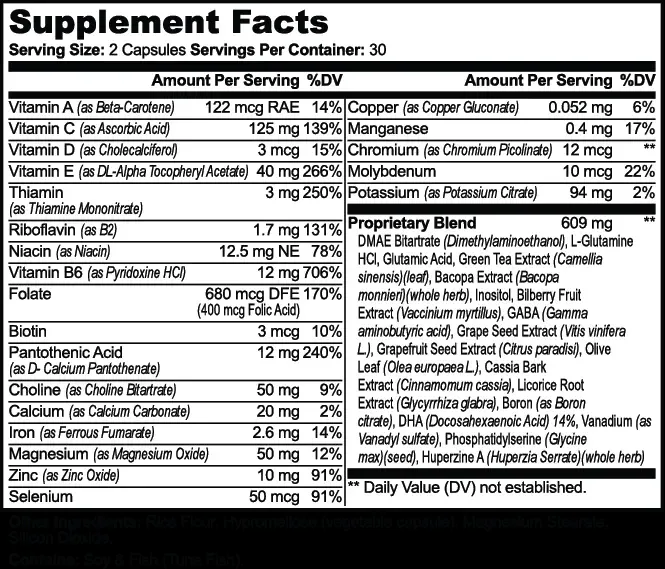
The MemoFixed label identifies phosphatidylserine as soy-derived and includes it within a 609 mg proprietary blend. Individual blend amounts are not disclosed. That makes it impossible to establish whether a two-capsule serving supplies either of the PS quantities tested in the Japanese trial.
The blend also includes Bacopa whole herb extract, Huperzine A, DHA 14% and other ingredients. Combining these does not demonstrate that the trial findings add together or that the finished supplement has been tested. The full MemoFixed ingredients page provides the complete label for a more informed discussion with your chemist.
Safety, allergies and medicines
The six-month trial reported no treatment-related adverse effects and no differences in the monitored blood markers and vital signs. That is useful information about the tested PS preparation in those participants, but a study of 78 people cannot rule out uncommon reactions or establish safety for every medical situation.
MemoFixed contains soy and fish (tuna). Do not use it if you are allergic to either, even though the capsule shell is vegetable-based. The safety of the whole product also depends on its other ingredients, your health and any medicines you take.
Ask a doctor or pharmacist before starting if you use prescriptions, take other supplements, have a medical condition or have surgery planned. Pregnancy, breastfeeding and use under 18 also need individual professional advice. Stop taking a product and seek advice if a suspected adverse reaction develops; do not assume it must be harmless because PS occurs naturally.
Making a practical choice about memory support
Bring a photograph of the whole label and a current medicine list to your appointment. Ask whether there is a clear reason to use the supplement, whether any ingredients overlap with what you already take, and how you would assess whether continuing makes sense. These questions are more helpful than a broad promise of better brain health.
If MemoFixed is considered suitable, its directions are two capsules once daily, 20–30 minutes before a meal with water, or as advised by your healthcare professional. Do not increase this to chase a research dose. Sleep, physical activity, hearing support where needed, and staying socially engaged remain useful topics for a broader memory-health conversation.
New or worsening memory difficulties deserve medical review, especially when they disrupt daily activities. A supplement purchase should not delay that discussion. An ingredient guide can explain the research, but cannot determine why a particular person is experiencing changes.
Our 180-day Aussie promise
Try MemoFixed for up to 180 days. If it's not right for you, email us for a refund of the product price. Refund policy
Common questions
What is phosphatidylserine?
A natural fat (phospholipid) found in cell membranes, especially in the brain. Supplements are usually made from soy or sunflower.
What is the best phosphatidylserine dose?
Studies commonly used 100–300 mg a day. MemoFixed's amount is part of its blend and not disclosed separately.
How long does phosphatidylserine take to work?
Studies ran for about 12 weeks to 6 months, so give any supplement containing it at least 8–12 weeks.
What are phosphatidylserine side effects?
It is usually well tolerated; stomach upset and trouble sleeping have been reported at higher doses.
Is soy phosphatidylserine safe with a soy allergy?
No. Avoid soy-derived phosphatidylserine, including MemoFixed, if you are allergic to soy.
Can I take phosphatidylserine with blood thinners?
Ask your pharmacist first, as it may interact with some medicines, including blood thinners.
What is phosphatidylserine used for?
Phosphatidylserine is a phospholipid included in some supplements marketed for memory support. Its role in cell membranes explains the research interest, but does not establish that a supplement will improve everyone’s memory.
Does soy phosphatidylserine improve memory?
A six-month trial found similar overall test improvements across PS and placebo groups, with a more encouraging signal in participants with lower starting scores. That mixed result needs cautious interpretation rather than a blanket claim of effectiveness.
How much phosphatidylserine is in MemoFixed?
The individual PS amount is not disclosed. It is one ingredient in a 609 mg blend, so the blend total cannot be used to calculate the PS dose.
Is MemoFixed phosphatidylserine soy-derived?
Yes, the label lists phosphatidylserine from soy. MemoFixed also contains fish (tuna), so both allergen warnings matter when deciding whether it is suitable.
Is 300 mg phosphatidylserine better than 100 mg?
The trial discussed here does not justify a simple rule that the higher amount is better for everyone. Neither amount can be matched to MemoFixed because its PS quantity is undisclosed.
How quickly does phosphatidylserine work?
The cited study assessed supplementation over six months, not an immediate boost. It cannot provide a promised onset time for PS generally or for an untested multi-ingredient product.
Can I take phosphatidylserine with my medicines?
Have a doctor or pharmacist check the exact product first. With MemoFixed, the review needs to include the entire blend, vitamins and minerals rather than PS alone.
Can phosphatidylserine prevent dementia?
The trial summarised here does not establish dementia prevention. MemoFixed is not intended to treat, prevent or diagnose disease, and persistent memory concerns should be assessed by a healthcare professional.
- Free shipping Australia-wide
- 180-day money-back guarantee
- Secure Shopify checkout
- Prices in AUD